

Studio C Sign
Stucio C took part in the realization of visual effects for more than 350 shots for the movie “The Chronicles of Narnia: …
Stucio C took part in the realization of visual effects for more than 350 shots for the movie “The Chronicles of Narnia: …

La esquina means the corner so what a fitting name for this restaurant and shop located on a corner house one block …

In La Antigua Guatemala people really go the extra mile to show they care about each other. If one is creative, all …

Trust me, do no trust your nostalgic memories; they will mislead you. 🙁 Today’s sign of al Macarone is a very good …

When was the last time you had chocobananos or chocofresas? Do you know what they are?

Last month I shared with you La Antigua Guatemala Sign Ordinances. I will again post the information below to keep fresh. One …

Beautiful, simple and elegant sign made with six ceramic tiles. Now, I wish I knew what they do or sell at Alforja. …

Perhaps the fact that I am a graphic designer is what causes me to stop and take pictures of signs in La …

Pollo Campero is Guatemala’s most successful transnational company. With its tender, juicy and crunchy fried chicken, Campero has done what other Central …

So, finally I have gotten a copy of La Antigua Guatemala’s sign ordinances. I received two legal-size pages with almost Illegible text …

We continue feeding the sign category with a sign made from ceramic tiles. There are over 106 sign entries thus far. You …

Okay, so I’m going to need some help with this one. I know Rudy has an abundant sign collection and I thought …

I believe the Muni should begin posting these signs all over town. Let licuado lovers be aware!

When he had fished the last fish, poison the last river, and cut down the last tree, man will realize that he …

127 cities around the world orchestrated a global effort to show the different manifestations of the concept of BIG. I could have …

Continuing with the night photography thread from the Theme Day, we also add number 101 sign to overflowing Sign category. If you …

I am always amazed by the great quantity and quality of the signage in La Antigua Guatemala. Incredible that even though signs …

Just by walking around the streets of La Antigua Guatemala you can learn a whole new vocabulary by reading sings. If you …

I love signs; as the Sign category can testify with 98 entries so far. I am sorry about that since you have …

Café Barista is the newest hipster kid on the block in La Antigua Guatemala. Café Barista opened its doors the week before …

Okay, here’s a sign of restaurant exploiting the fact that everybody knows all grandmothers prepare the best food and have the most …

This is the actual plaque, in which, chiseled over a piece of stone you can read the UNESCO’s declaration of Patrimony of …

As requested by many readers of La Antigua Guatemala Daily Photo, here are the new parking/entrance fee regulations of La Antigua Guatemala. …

Oh I really like the texture and shape of this sign. Do you know what pietra is? It’s not a Spanish word.

According to the statistics only 67% of the population has Internet access in Guatemala (source somewhere in elperiodico.com.gt or prensalibre.com.gt), but by …

One of favorite sections of the Los Angeles Times used to be Only in LA and I believe that when I started …

With new Municipal government in 2008 came some rather obvious nice things that were missing from the main entrance to La Antigua …

Every year, On January 15th, thousands of pilgrims from Guatemala, the United States, Europe and other Central American countries flock to pay …

Okay, if you have followed the daily dispatches from La Antigua Guatemala Daily Photo for a while, you would remember that back …

About a month ago I reported that La Antigua Guatemala had become the first digital city in Central America, but I did …

Back in December 26, 2006 I wrote about the banking war in Central America between Citibank and HSBC Bank over the access …

Acuario is the Spanish word for aquarium and Don Chobe is the only shop in La Antigua Guatemala that caters exclusively to …

It’s amazing how creative are the sign makers around La Antigua Guatemala. A quick glance at the Signs category can show the …

I became contagious with the regular twitter updates about gasoline prices going down in Guatemala, so the very next time I went …

Some businesses just feel the need to have a sign hanging for every one of their services. 🙁

I really like the naí¯f aspects of this sign. I like how the composition is trying very hard to include all the …

Don’t you ever say I don’t take you deep into the most obscure holes of La Antigua Guatemala in search of the …

La Antigua Guatemala is so full of antique signs that you can find while strolling around the ruins, buildings and parks. Today’s …

I am sure that most people that visit La Antigua Guatemala get to see the fountain at the Main Square; some might …

Believe it or not what you call the Santa Lucía Street is the biggest controversy on this 6-block-long avenue. See, most people …

Here’s a second wooden sign for the Sabe Rico Delicatessen Chocolatería which can be found hanging at the entrance doorway. I really …

Obviously not all the signs are for new business. Sometimes, there are business which did not succeed and their local is taken …

I said it before, but I repeat it now: I could go on forever photographing the never-ending supply of signs around Antigua. …

I wonder what was going through the old man’s mind while watching the young tourist with flip flops (thongs) and short shorts. …

Quick question, what does Tres tiempos mean for a tortilleria?

More than once I have explained my method of taking photographs around La Antigua Guatemala. Back in April 23rd, 207, I explained …

We know it’s in your hand. 😉

This is another tradition which is disappearing from the façades of La Antigua Guatemala. Having a tiled-sign with the family names on …

The Marimba Orquesta Ave Lira Sign is so small that you may have trouble finding their home-base. I have published a photo …

Okay, I need your help translating the word “licuados” into English? What do you think would be a good option?

I guess we can continue a mini series of signs… here’s the most common sign seen in La Antigua Guatemala. Sometimes you …

If I started a series about the NGOs (Non Governmental Organizations) headquartered in La Antigua Guatemala, one per day, I could probably …

Pues, what better way to explain one of the most confusing word-expressions in the Spanish language than to tell you about Manolo, …

Did I miss a fútbol (Soccer) game today, or what? I know Bistrot Cinq is a French bistro on 4a calle oriente …

If you are in Guatemala this weekend, you can visit all public and most private museums for free. May 18th is the …

This is the technical data sign in front of the Esquisuchil Tree or Tree of Santo Hermano Pedro. Come back tomorrow for …

Don’t we all? ¡Sí se puede! (Yes we can!) 😉

The poster above is about a concert promoting the Human Rights in Guatemala. The concert was held in La Antigua Guatemala’s Central …

As the U.S. real estate market plummets, especially the sub-prime real estate, the Guatemalan real estate market grows even healthier, especially in …

Sometimes just showing a sign can be considered a political act. Today’s photo about one particular architect’s sign falls under the political …

Today we resume the sign fetish series. How do you get this vigorous red color? First you find red wall looking west …

All the weekends of Lent (Cuaresma) and during the Holy Week La Municipalidad de La Antigua Guatemala (Municipality or City Hall) imposes …

Sol Latino is a band that plays mostly Andean and Latin American music. For a long time Sol Latino wonder around the different venues and bar/restaurant circuit in La Antigua Guatemala. Eventually, they managed to get an investor to open up a restaurant-bar so they could have their own stage where to play every night. La Peña de Sol Latino became their home base; thus, they needed to wonder no more.

Here’s a hypothetical question for you. In Guatemala, who has the right of way among these options: pedestrian, bicycle, motorcycle, car, bus, truck, eighteen-wheeler truck? If you plan to visit Guatemala, you must know the answer before you arrive.

Are pirujos and shucos sandwiches getting out of hand? Come on, who can eat a sandwich this big. Just to clarify, the …

No Food, No Cameras, No Guns, No Backpackers and No Private Guards inside, the sign reads. Only in Guatemala you can find this kind of signs (I think). Guns are a big trouble, you know; people do crazy things with them and not only in Guatemala; naked guns are worn in the belts like cellphones or keychains; even banks and offices have an unusual piece of furniture to deposit customers’ guns at the entrance. Certainly Guatemala is not the only gun-crazy country in the world, nevertheless, it sad to see signs like the one above, captured at Angelina’s Doorway.
My condolences to the families and friends of the students who lost their lives yesterday in Illinois. 🙁

Valentine’s Day in Guatemala is known as El Día del Cariño. Cariño and caress share the same etymology and it means affection. The Day of Affection would be a close translation for El Día del Cariño, thus it is much more than Valentine’s Day because it is the day to show your affection, love and appreciation to your co-workers, neighbors, friends, family, and of course, your girlfriend or girlfriend; whatever the case may be.

Signs: They come with all kinds messages; some with weird information too.
If you’ve been visiting La Antigua Guatemala Daily Photo for a month or longer, you will know that the sign category gets a lot of attention from my viewfinder. You can browse the sign category to see 48 samples of the different signs capture thus far.

John Rexer, New Yorker by birth, Mexican by heart and Antigüeño by choice, came to La Antigua Guatemala a few years ago and after surfing the local scene, he realized a joint was needed for backpackers, hippies, ex-pats and others looking for the other side, the flip side, of LAG. A sort of bohemian atmosphere where people were free to express their artistic vein, or simply to relax while eating the local variant of Tex-Mex food or drinking cheap beers or his own Ilegal Mezcal brand (the generic name for Tequila-like agave distills).

I found out about the sign above via Buried Mirror and I knew a mini series was long over due about this hippie joint in La Antigua Guatemala.
Do you know what place am I talking about?
Who ever came out with this great idea for a sign, for sure, was a hippie who now is very wealthy. Check out this amazing slide show that reveals all the different places where the sign has been posted.

COLOMBIA SANS FARC, the sign reads.

This is the welcoming display sign that you can find in the hallway that connects the underground parking lot and the Hotel-Museo Casa Santo Domingo in La Antigua Guatemala. Although, there is no reference element in the picture to give you an idea of the size of the sign, I can tell you is very big; the red background of the display must be about 3 meters by 2 meters (9 feet by 6 feet).

If you have lived for a while in the ‘first world’, make sure you know how to read this sign. Sanitarios is the Spanish word used in Guatemala for bathrooms. Make sure to memorize it, otherwise you will be running like this little girl. 😉
Don’t you just love this Sanitarios sign… see how can I not suffer a fetish for signs in La Antigua Guatemala when even the most mundane sign is made to look aesthetically pleasing.

Have I told you about my sign fetish… I don’t know if a cure exist for this sing disorder, but for sure La Antigua Guatemala signs do not help; there are SO MANY of them.
Do you know the etymology of fetish? If not you can find in this site… go happy h

Fumar es causa de cancer (smoking is cause of cancer)
The warning above is not used in Guatemala. I have only seen it used in Mexico. In Guatemala, the warning on the cigarette boxes is pretty explicit Smoking will kill you, period.

This is a very simple and effective way to discourage the patronizing of the competition. Sign seen at Los Mojados Taquería (The Wetback Taco restaurant).

For some unknown reason, many Guatemalans opt for misspelled Spanish bastardizations of English words to name their businesses. For instance, the image above has the name Stilos (Estilos is the proper Spanish spelling) as a way to relate to Styles the English word for this barbershop (peluqueria in Spanish).

As of 22 hours local time of Sunday 4th of November, Guatemala’s Electoral Supreme Tribunal or Tribunal Supremo Electoral (TSE) in Spanish has declared the Socal-Democrat Alvaro Colom as the new elected president of Guatemala.

The above yellow corner is located on 1a calle poniente in La Antigua Guatemala. The Astoria delicatessen is just one of many delicatessen in La Antigua Guatemala. We are privileged in this aspect with access to some fine and exclusive ingredients. La Antigua Guatemala is a tiny town that wants to be a huge cosmopolitan metropolis, but without the traffic, rush hours, or smog. Let it dream!

The Fetish Etymology Side Note: First there was the Spanish word Hechizo (witch craft or witch-made) which turned into Feitiço in Portuguese. The Portuguese Feitiço swam over the North Sea to France and became Fetiche (actually, between you and I, Feitiço flew to France on a broom; but since we are talking about the XV century we don’t want to risk misinterpretation, you know). Once in France it was only a matter of time for the English to snatched the foreign-sounding word, but because they did not how to spell it, Fetiche became Fetish. Unfortunately this was at the time when the Europeans were trading with humans from Africa and because they did not know much about Africans religions they use the word fetish to denominate all those religious rituals. Karl Marx felt that merchandise possessed a bewitching aspect and thus it was evil, so he called this malicious attraction a fetish. Once in the German language, it was only a matter of time (again) for mister Sigmund Freud to muddle with its meaning to apply it to the phenomena he was observing in his clinic. With this last meaning fetish (fetiche in Spanish) came back to its mother tongue; completely transformed.

The first time I ever heard about La Naranja Pelada (The Peeled Orange) was at Inner Diablog, a blog published from London but filled with hindsight and hard-to-find information about Guatemala. On top of all, Guy writes so eloquently that it is a pleasure to read his entries. Honest, this blog and his writing is an inspiration for me. Check it out!
In the area around Antigua the best ceviches are to be found in a small seafood restaurant on a backstreet of Jocotenango called La Naranja Pelada. The dining room is wood-panelled and decorated with specimens of local ‘game’ such as snakes, turtles and armadilloes. (source: Inner Diablog)

After all those years, all those rainy seasons, all those earthquakes this old wall still stands.

Even though La Antigua Guatemala is a very photogenic town and that is virtually impossible to take a bad photo of this …

I think this Subway franchise will have to use its second slogan: The Way A Sandwich Should Be because the Eat fresh may not work in a place like Antigua Guatemala, where most places serve REAL fresh food. With all of these transnational fast-food restaurants in La Antigua Guatemala, we still have to make a run for the border or drive to Guatemala City if we’d like to think outside the bun while enjoying a bean and cheese burrito.

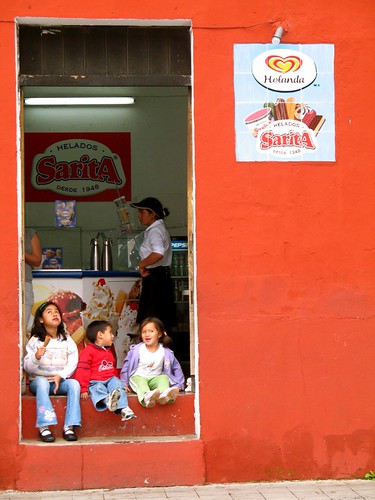
Helados Sarita, on 5a calle poniente, is the meeting place for these three kids and their joyful smiles. Sometimes life can be beautifully simple and full of joy (even for adults).

We continue with “the sign fetish” and today’s turn is for La Tienda de Doña Gavi sign. Believe it or not, this tiny store is one of La Antigua Guatemala landmarks and it’s located on the street behind the Cathedral. Doña Gavi sells all kinds of organic stuff in this cozy shop including avocado ice cream. If you come to Antigua, you must visit this shop. If you don’t trust my recommendation, read the On the Road Travel recommendation below:

I am a sucker for signs and La Antigua Guatemala has an amazing palette of signs made from wood, ceramic tiles, metal, paint, glass, etc. Perhaps, I am sensitive to signs because of my graphic design background or maybe because I am sign junkie. I like the colors, the materials and sometimes simply the typography used. The sign above is made from metal, welded together and installed at entrance of the parking lot of Porta Hotel Antigua with a gorgeous hand-made typeface. Sorry, I said I am sign addict and since I try to show you what one is expected to find while strolling around Antigua Guatemala.

This coming Sunday Guatemala will be holding general elections for president, vice-president, congress curule seats, and city mayors throughout the country. It is sad to read the news feeds and news headlines regarding Guatemala. It seems like this tiny ‘paradisiac’ banana coffee republic has an innate quality to generate bad press. Like Tarzan, Guatemala jumps from bad stories to worse stories. It is a true jungle out here.
In the meantime, Guatemalans will cross their ballots to exercise the democracy Mayan ball game. But, before that, they must know where exactly they will cast their vote and for that, they have to go to one of the many citizens’ registration booths; like the one pictured above in the entrance to La Antigua Guatemala.

As I negotiated my acrobatic skills over the stone, looked back so I don’t get ran over or splashed by one of the uncivilized drivers, looked at the camera so I don’t ruin it with the running dirty water, composed the shot to include both elements, I took a couple of shots to get the best composition. As I was ready to put away the camera and moved away from the center of the street because two vehicles were using their horns to alert me that they were close and they had no mercy; this lady entered the frame; I did see her with my own eyes as I was looking down to the twist-out viewfinder paralleled to the floor; I had but fleeing second to take the shot and this fraction of a second my mind went through all countless photographs warehoused in my memory so fast that I must remember over thousand images until my brain did a full stop at one my favorite images ever: The Decisive Moment by Henri Cartier-Bresson. With that image in my head, I pressed the shutter release. Next, I pulled away from the centre of the street just in time as the vehicle behind me went by making a big splash (I did not get wet), pulled my eye sight to see that the lady did not fall and was already walking away in the opposite direction.

Unless you have taken the path of La Marche de l’empereur, you haven’t heard about how everyone is living a virtual second life through a community web site. Well, old and retired school buses from the U.S. get to live a real second life as camionetas (the street name for public transit buses in Guatemala). Revue Magazine had an in-depth article about The Birth of a Camioneta (available as a PDF download) which detailed step-by-step how an old retired school bus became a powerful camioneta ready for the curvy roads of the mountain ranges of Guatemala.

Calzada Santa Lucía gets overcrowded with all the stands of the 11 candidates for the La Antigua Guatemala City Hall or Muni as we call it here. They all have their booths, their chants and songs, their promises, their colors, their flyers, their visual and hearing pollution, their trash, et-cetera.

This photograph marks the beginning of the San Lázaro Cemetery series. I know Friday is a weird day to start a series, but since most people visit the cemetery on the weekends, I guess it’s okay. I have to warn you about the series though. This cemetery is not exceptional and quite frankly a little boring since it is mostly white. So, don’t expect any extraordinary or exotic shots.

In La Antigua Guatemala even transnational companies have to bend their rules of signage and corporate identity to blend and be in harmony with the architecture and colonial style of the town. Check out the Transnational series signs I did back in October 2006.

Obviously what they sell there has not influenced my appreciation for this wonderful light-blue, celeste in Guatemalan Spanish, corner. I simply liked the light hitting the building and the tourist walking by that afternoon. Also, I like the geometry of the white stripes, the Joyería del Ángel sign and the lamp. You will have to excuse the white sky in many of the photos taken during the rainy season; not much I can do.

There are three cell phone companies in Guatemala (4 according to Wikipedia). Tigo is the mobile phone brand of Millicom International Cellular. Claro mobile telephone operator is owned by the Mexican group América Móvil, which in turn is the umbrella name for the mobile telephone division of Telmex, owned by Carlos Slim (estimated fortune of US$67.8 billion). Carlos Slim’s empire also owns the Guatemalan National Telephone Company, Telgua, and Telgua’s division of cellphone Claro brand. Movistar is the mobile division of the Spanish transnational Telefónica telephone company. Believe it or not the Telmex/América Móvil and Movistar/Telefónica are probably bigger than AT&T.

The English-language speaking community refuses to recognize the official name of La Antigua Guatemala because it is too long or lack of knowledge or poor Spanish-language skills; who knows really?. They just want to call it Antigua. But Antigua is a Caribbean Island. Yet, they refuse to call it La Antigua Guatemala, which, by the way, simply means the former Guatemala City.
To add to this confusion, many Guatemalans just call it Antigua too, although more often they say La Antigua. This error is even published by newspapers and magazine. Worst yet, the road signs just say Antigua Guatemala. Even Wikipedia just have it listed as Antigua Guatemala, which by the way means Old Guatemala.

The Antigua Guatemala is full plaques pointing to historic sites or events that happened here. The Antigüeños must luck the humor or …

The flavor in life is found in the little details. The transit signs in La Antigua Guatemala are a very good example of that. You take something boring but necessary as a stop sign and turn it into a beautiful detail; which makes your walks around town a little more pleasant to the eyesight. The stop signs (alto in Spanish) in La Antigua Guatemala are made from red ceramic tiles and metal frames.

Soon everyone will be familiar with this logotype. Resistance is futile, all of you will be assimilated, we are the borg-campero. Juan José Gutiérrez and Dionisio Gutiérrez remind me of Pinky and The Brain because of their new weekly plans to take over the world. The first plan began over 35 years ago, 1971 to be precise, in tiny joint in Guatemala City. Their plan was very simple: let’s make a clone of Kentucky Fried Chicken and let’s sell it the world over. So far their plan has taken as far many U.S. cities, Madrid and Jakarta and in ten days to Shanghai. In China, Pinky and The Brain Gutiérrez plan to open up 500 new restaurants in the next five years; that is little over 8 restaurants per month. The Gutiérrez plan is to convince-convert the world over to their recipe of fried chicken which is tender, juicy and crunchy by way of plain logic: after all, how can 1.7 billion Chinese be wrong, right?